Were Geisha Girls Originally Men?
Yes, the first geisha were men, male entertainers called taikomochi, and the first female geisha appeared in 1751, which answers were geisha girls originally men. This page shows how fast women took over, with Yoshiwara counts from 1770 to 1800, explains why foreigners say geisha girl and what mizuage was, and says what the few men still in the trade do before pointing you to a geisha show Kyoto visitors can actually book.
Quick answer
Yes: the first geisha were male entertainers, and the first female geisha appeared in 1751, according to Wikipedia, with women dominating the profession by about 1800.
Key takeaways
- Taikomochi, also called hokan, are described as the original male geisha of Japan, entertaining at banquets with jokes, games and skits
- The first woman to call herself geisha was a Fukagawa dancing girl named Kikuya, around 1750, and female geisha worked beside male geisha for decades
- In Yoshiwara, women overtook men between 1770 and 1775, and by 1800 there were 143 female geisha against 45 male, Wikipedia's Taikomochi article cites
- The phrase geisha girl is a post-war foreign coinage that often meant sex workers, and has nothing to do with Kyoto's geiko
- Only a handful of professional taikomochi still work, mostly in Tokyo, so men in this role are very rare today
- To meet today's women of the tradition, a meet-a-maiko show or the one-hour show with a Q&A is the realistic way
Where can you meet the women of the tradition today?
Today's geiko and maiko are women, and a booked show is the simplest way to see their dance and music in a room built for visitors.
 from $48
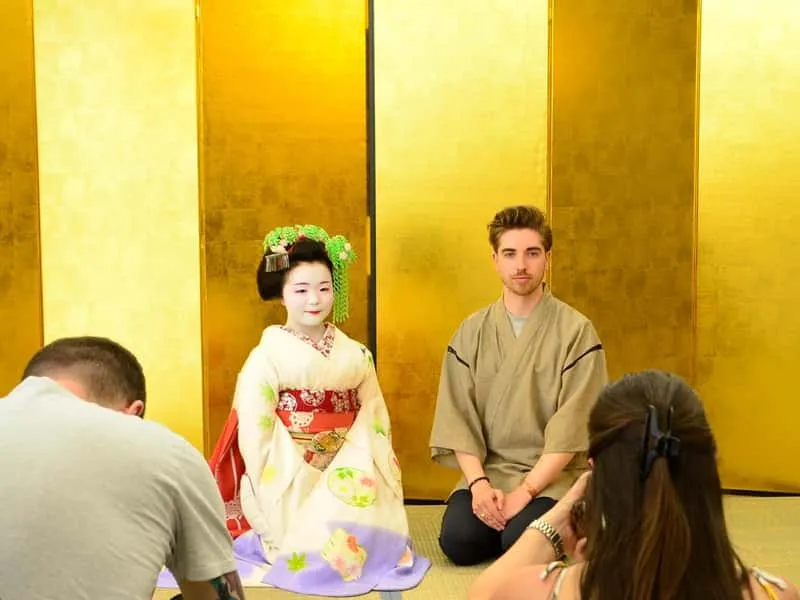
Meet a Real Kyoto Maiko — Intimate Show, Stories & Keepsake Photo
An affordable meet-and-greet with a Kyoto maiko, including a short dance, a friendly chat about apprentice life, and a keepsake photo. The most budget-friendly way to meet a…
- Meet and greet a real Kyoto maiko
- Short traditional dance performance
- Learn about apprentice geisha life
- Keepsake photo included — best value option
 from $81
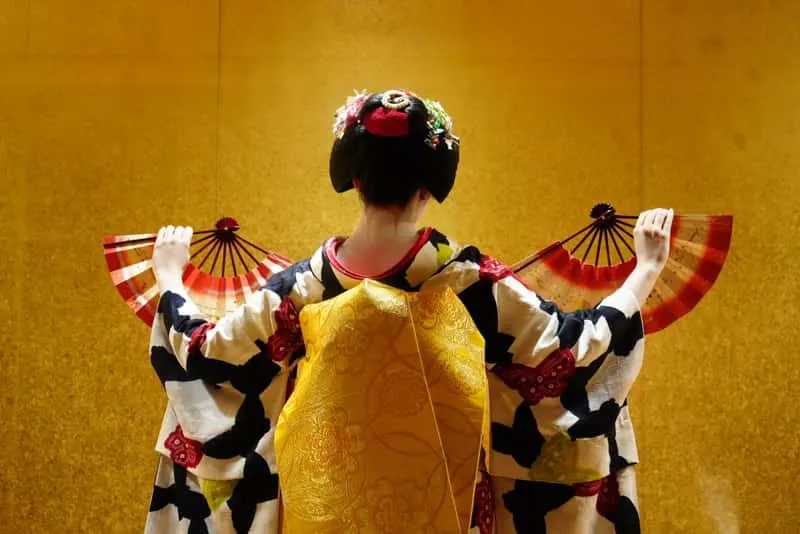
Authentic One-Hour Kyoto Geisha Show with Live Q&A and Photos
A focused one-hour geisha show in Kyoto featuring a live dance performance, an interactive Q&A, and a photo session with the performer. A quick, authentic way to see…
- Live geisha dance performance
- Interactive question-and-answer session
- Photos with the geisha included
- Near Kitano Tenmangu Shrine — easy to combine
 from $105
Gion Geisha Show & Cultural Walk with Traditional Dining
Stroll the lantern-lit lanes of Gion with a local guide, then watch an authentic geisha show in Kyoto before sitting down to a traditional Japanese meal. Combines a…
- Guided walk through Gion, Kyoto's historic geisha district
- Live geisha or maiko performance up close
- Traditional Japanese dining included
- Small group for an intimate cultural evening
Were geisha girls originally men?
Yes. Wikipedia's article on geisha states that the first female geisha appeared in 1751 and that geisha before that time were male performers who entertained guests. Only later did the profession become mainly female.
The word itself says why: geisha means person of the arts, and National Geographic quotes the Minnesota professor Maki Isaka saying that the term is not necessarily gendered and that a female counterpart needed a gender marker in some regions.
Women came from several sources at once, and by 1800 they outnumbered the men in Edo's Yoshiwara quarter by about three to one.
Source: Wikipedia, National Geographic.
Who were the first male geisha?
They were the taikomochi, a word written with characters meaning drum and bearer, also read as hokan. Wikipedia calls them the original male geisha of Japan and traces taikomochi as attendants to feudal lords from the thirteenth century, with a link to the dance-centred Ji sect of Pure Land Buddhism. By the sixteenth century they were called otogishu or hanashishu, the companions and storytellers of the powerful.
In the pleasure quarters their work was entertaining the party. Wikipedia's article on them describes party masters who kept guests amused with jokes, tales, skits, games and sake drinking. Its geisha article says some early geisha were travelling male entertainers who went from party to party entertaining the customers of courtesans through song and dance.
National Geographic adds a second layer. Isaka says that in Edo-era theatre publications from the late seventeenth to early eighteenth century, geisha usually meant a kabuki actor, and kabuki actors were by default male. So the word first described a skill, not a sex.
Source: Wikipedia: Taikomochi, Wikipedia, National Geographic.
When did women become geisha?
Around 1750, in Edo's Fukagawa quarter. Wikipedia says the first woman known to have called herself geisha was a dancing girl from Fukagawa who had become a skilled singer and shamisen player. She took the name Kikuya, and her success made the idea of female geisha popular.
Many girls then built reputations as musicians, dancers or poets instead of becoming prostitutes.
Female forerunners had grown from the teenage odoriko, dancing girls hired as chaste dancers within teahouses, and from some courtesans who stayed on to provide music after their contracts ended. The toki.tokyo history site dates the first male geisha to about 1730 and says women followed roughly twenty years later. For women's first documented use of the word, Wikipedia's 1751 date is the one to quote.
Source: Wikipedia, toki.tokyo.
How fast did women take over?
This table follows the shift from male to female geisha, using the Yoshiwara counts that Wikipedia's Taikomochi article attributes to Lesley Downer and the dates in its geisha article.
| Year | What the record shows | Source |
|---|---|---|
| Around 1700 | The first geisha, many of them men, perform song and dance for customers of courtesans | Wikipedia |
| About 1730 | Male geisha, taikomochi or hokan, appear in the form the history sites describe | toki.tokyo |
| About 1750 to 1751 | Kikuya of Fukagawa and the first female geisha | Wikipedia |
| 1770 | Yoshiwara has 16 female geisha and 31 male | Wikipedia, citing Downer |
| 1775 | 33 female and 31 male, the two nearly level | Wikipedia, citing Downer |
| 1800 | 143 female and 45 male, and the profession is understood as almost entirely female | Wikipedia, citing Downer |
The pattern is clear in the counts. Women went from about one third of the Yoshiwara total to more than three quarters in thirty years, and the men did not vanish. Wikipedia notes that the new female performers often worked in the same establishments as male geisha.
That mix explains why sources give different dates for the changeover.
The dates cluster in the 1750s and the numbers in the 1770s. The Yoshiwara counts come from one author's book, so read them as a guide to the trend.
Source: Wikipedia: Taikomochi, Wikipedia, toki.tokyo.
Why did women replace men as geisha?
Historians give no single cause, but Wikipedia shows what the women offered. They sang, danced and played the shamisen, which the men had also done, and they were hired in teahouses as skilled performers. Kikuya's success made the profession respectable for girls who would otherwise have gone into prostitution, and within two decades female geisha were well known for their talents in their own right.
The Inside Japan Tours blog adds that the first male geisha were not allowed direct contact with guests in the oiran's rooms, because the oiran feared they would steal customers. That is a tour company's account, not a historian's. What the record does support is that women arrived through music and dance, not through the men's role of joke-teller and party master.
Source: Wikipedia, Inside Japan Tours.
What did geisha inherit from the men's world?
The stage arts. Wikipedia says the style of dance geisha practise today evolved from the dance styles of noh and kabuki theatre, where over time the more exaggerated theatrical forms became the subtle, stylised dance seen now. The same article notes that the geisha's public dances, the odori, date to the Kyoto exhibition of 1872 and are held every year in all of Kyoto's districts.
National Geographic points out another link. The striking white makeup is also found in kabuki and in the pale masks of noh theatre, and geisha houses follow the same hierarchical system of passing knowledge down as those theatres do. A modern maiko learns her art from senior women inside a system built like the old performing arts.
So the men's shadow is visible in the craft even where no man is in the room.
Source: Wikipedia, National Geographic.
Why do people say geisha girl?
Because of a wartime and post-war misunderstanding. The toki.tokyo history explains that during the post-war occupation, many US soldiers had their first contact with Japanese culture and picked up the phrase geisha girls, an American mispronunciation and sweeping label for female workers in Japan that included prostitutes and nightclub hostesses but rarely actual geisha. Some women in the sex industry dressed up and claimed to be geisha to attract Western clients.
That is why Kyoto's women prefer geiko, and why this site uses it. Japan's Prostitution Prevention Law, passed in 1956 and fully in force from April 1958, criminalised most prostitution, and Wikipedia says geisha were not part of that trade. The phrase geisha girl also hides something the history above shows: for its first decades the word was not gendered at all.
Source: toki.tokyo, Wikipedia.
What was mizuage, and is it still practised?
Mizuage was a rite of passage that toki.tokyo describes as a ritual in which a young woman loses her virginity, usually to a bidding suitor, as she is about to become a full geisha. Memoirs of a Geisha made it famous abroad. The same history notes that the practice was not followed by every geisha community and was discouraged in many.
The legal ending is clear. Wikipedia says the Prostitution Prevention Law, passed in 1956 and fully in force from April 1958, criminalised practices such as mizuage, which had at times been undertaken coercively or through force by some maiko in mostly pre-war Japan. It has no place in a geisha's life today.
The misconception that it was common continues, Wikipedia adds, and it is inaccurate. A maiko's actual step to geiko is the erikae, the turning of the collar, explained in geiko versus maiko.
Source: toki.tokyo, Wikipedia.
Are there male geisha today?
A handful. Only a few professional taikomochi still work in Japan, most of them in Tokyo, and published counts of them disagree.
They work at the same kind of party the geisha attend. Wikipedia's article describes taikomochi who entertain at ozashiki, and says that once women became the majority, men in the role were called otoko geisha, male geisha, and supported the women at parties. A visitor will almost never meet one, because they work in private banquets and not in the shows built for tourists.
Source: Wikipedia: Taikomochi.
What roles do men have in a geisha district today?
This table lists the roles Wikipedia says men take in the karyukai, the flower and willow world, which is almost entirely owned and run by women.
| Role | What the man does | Why it matters to the women |
|---|---|---|
| Hair stylist | Dresses the hair and wig | A maiko's own hair is styled on a fixed schedule |
| Dresser, otokoshi | Dresses a maiko in her kimono | Wikipedia notes dressing a maiko takes considerable strength |
| Accountant | Keeps the books of the house | The okiya is a business with debts and fees |
| Head of a dance or music school | Teaches and holds the school's legacy | The women train under these schools |
None of these men performs the geisha's role. Wikipedia describes geisha as some of the most successful businesswomen in Japan, with almost the entire world of the karyukai owned and run by women. The women of Kyoto's tradition are counted at about 161 geiko and 68 maiko across the five districts in 2021, according to National Geographic, and Gion Kobu alone had 79 geiko and maiko in 2025, per Premium Japan.
For the profession's size today, see do geisha girls still exist today.
Source: Wikipedia, National Geographic, Premium Japan.
What is the realistic way to see the tradition today?
Book a show in which a maiko or geiko performs, since that is the form of the art open to visitors. A real banquet is by introduction only, and our guide to what a geisha actually does shows what happens at one. Public stage dances such as the Miyako Odori run each April, and the cheaper bookings fit any evening.
The meet-a-maiko show is a 45-minute dance, stories and a keepsake photo for $48. The one-hour show with a Q&A runs $81 and leaves room to ask how the profession began. The Gion dinner show adds a guided walk and a meal for $105.
Browse every Kyoto geisha show on the homepage.
Frequently Asked Questions
What is a male geisha called?
Taikomochi or hokan. Wikipedia says men in the role were also called otoko geisha once women became the majority.
When did the first female geisha appear?
In 1751 by Wikipedia's date, with a Fukagawa dancing girl named Kikuya around 1750.
Did geisha ever sell their virginity?
Mizuage, a rite of passage, was at times coerced in mostly pre-war Japan, Wikipedia says, and the law that took effect in 1958 criminalised it.
Are geisha girls prostitutes?
No. The phrase geisha girls was a post-war foreign coinage that lumped sex workers together with geisha, toki.tokyo explains.
Can a man become a geiko?
No. Kyoto's geiko and maiko are all women. The few remaining male performers work as taikomochi, mostly in Tokyo.
Why does Kyoto say geiko?
It is the Kyoto word for a fully trained geisha, and maiko is the apprentice. See geiko versus maiko.