Geisha, Geiko or Maiko? How to Tell Kyoto's Performers Apart
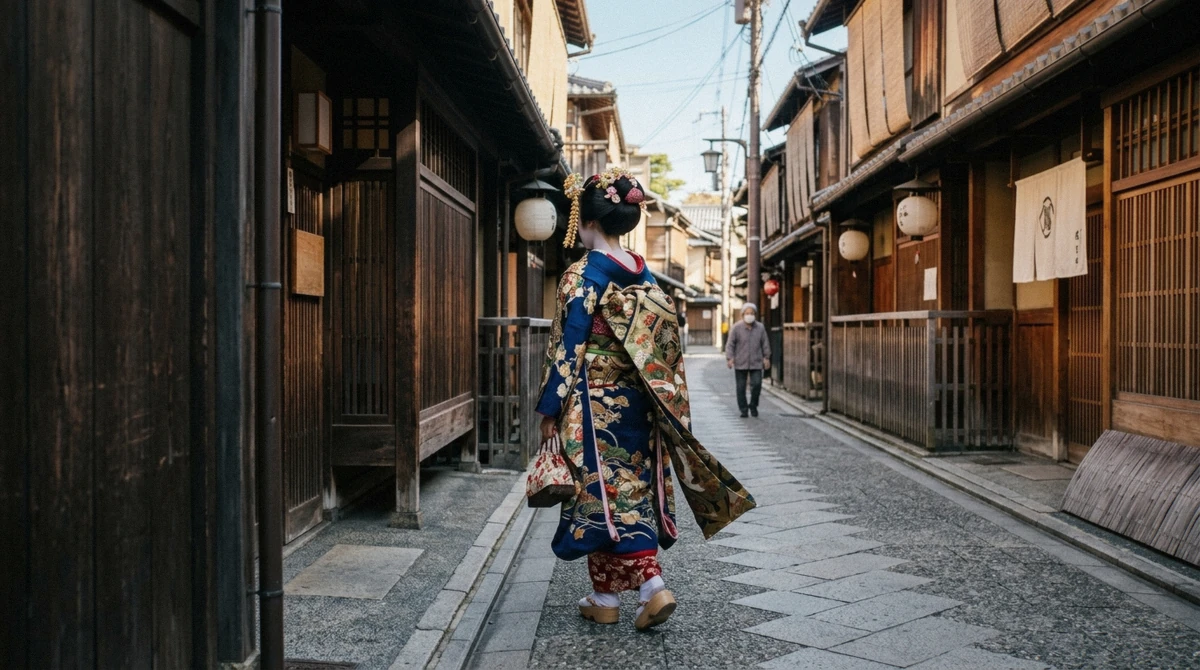
The difference between geisha and maiko comes down to one word and one stage of a career: maiko is the apprentice, still training, still finding her own sleeves too long for her arms; geiko is the qualified professional Kyoto people actually mean when outsiders say geisha. Once you know that, the rest is visual. A maiko's kimono trails, her hair is her own, her sandals are tall and wooden. A geiko's kimono is shorter and plainer, her hair is a wig, her sandals are flat. We walk through both in detail below, district by district, so you can read a photograph or a passing kimono correctly. For the full lineup of ways to meet one, see our Kyoto maiko and geiko experiences.
Quick answer
A maiko is the apprentice, roughly 15 to 20 years old, still training and easy to spot by her long trailing sleeves, dangling obi and tall wooden sandals. A geiko is the qualified professional, Kyoto's own word for what outsiders call a geisha, in a shorter kimono, a shorter tied obi and a wig rather than her own hair. Both are performing artists, not sex workers, and both work across five historic districts in Kyoto today.
Key takeaways
- Geiko is Kyoto's own word for a fully trained geisha; maiko is the apprentice stage before her
- The fastest tell: long trailing sleeves and dangling obi mean maiko, shorter and plainer means geiko
- Training runs about five years, ending in a ceremony called erikae
- Five districts hold this tradition today; see the table below for where each one is
- Want to meet the apprentice stage specifically? A private hour with a maiko puts her dance and conversation right in front of you
- For the honest question of how staged these bookings are, read are Kyoto geisha shows authentic
What the three words mean
"Geisha" is the word the rest of Japan uses; it means, literally, arts person. In Kyoto the word for a fully qualified woman in this profession is geiko: geiko is the Kyoto word for geisha, and it is the word Kyoto people actually use about their own community. We use geiko throughout this site for that reason, and use "geisha" mainly in headings, because that is how most readers search for the topic in the first place.
- Geisha: the national word for the profession, used everywhere in Japan outside Kyoto
- Geiko: the Kyoto word for the same qualified professional; the word this city's own community uses
- Maiko: literally "dancing child", the apprentice stage that comes before geiko, usually between the ages of about 15 and 20
A maiko's apprenticeship runs about five years. It ends with a ceremony called erikae, "turning of the collar", the formal moment a maiko's collar changes from red-and-white embroidered silk to plain white, marking her graduation to geiko. Everything else in this post, the sleeves, the obi, the hair, the makeup, follows from that single fact: one is still learning, one has finished.
Maiko and geiko side by side
The clearest way to see the difference is item by item, since almost everything a maiko wears signals apprenticeship and almost everything a geiko wears signals that the training is finished.
| Feature | Maiko | Geiko |
|---|---|---|
| Sleeves | Long, trailing furisode | Shorter, more restrained sleeves |
| Obi | Long dangling darari obi, tied low and left hanging | Shorter obi, tied and finished at the back |
| Hair | Her own hair, elaborately dressed | A wig, called a katsura |
| Hairpins | Elaborate, seasonal kanzashi, often changed monthly | Fewer, more restrained hairpins |
| Footwear | Tall wooden okobo platform sandals | Flat zori sandals |
| Makeup | In her first year, only the lower lip painted | Both lips painted |
| Age | Roughly 15 to 20, training | Any age from the early twenties up, qualified |
| Role in the room | Dances, listens more than she speaks | Leads the conversation, often plays shamisen for a maiko's dance |
Every column in that table exists because a maiko is still becoming who she will be, and the costume is built to say so at a glance, even to someone who has never seen either before.
How to tell them apart at a glance
If you only remember three things while looking at a photograph or a woman passing on the street, make it these. First, the sleeves: if they trail nearly to the ground, she is a maiko. Second, the hair: a maiko's elaborate style is her own hair pinned and set, a geiko's is a wig, which is why a geiko's hairstyle looks slightly less voluminous and more uniform.
Third, the walk: a maiko's tall okobo sandals give her a distinctive rocking gait; a geiko in flat zori moves more like anyone else in a kimono.
- Trailing sleeves and a dangling obi: maiko
- Her own elaborately pinned hair with seasonal kanzashi: maiko
- A rocking walk on tall wooden sandals: maiko
- Shorter sleeves and a tied, finished obi: geiko
- A wig with restrained hairpins: geiko
- A flatter, steadier walk on zori: geiko
The five hanamachi districts of Kyoto
Geiko and maiko work out of five historic districts, called hanamachi, or "flower towns". Four sit in or beside Gion in central Kyoto; the fifth, Kamishichiken, is across the city beside Kitano Tenmangu shrine and is the oldest of the five. Counts published in early 2026 put the working community at roughly 70 geiko and 25 maiko across all five districts combined, with Gion Kobu the largest.
| District | Where it is | Its theatre | Its annual public dance |
|---|---|---|---|
| Gion Kobu | Central Gion, Kyoto's best-known district | Gion Kobu Kaburenjo | Miyako Odori |
| Pontocho | A narrow lane between the Kamo River and Kiyamachi | Pontocho Kaburenjo | Kamogawa Odori |
| Miyagawacho | South of Gion, along the river | Miyagawacho Kaburenjo | Kyo Odori |
| Gion Higashi | Eastern Gion, the smallest of the four central districts | Gion Kaikan | Gion Odori |
| Kamishichiken | Beside Kitano Tenmangu shrine, across the city | Kamishichiken Kaburenjo | Kitano Odori |
Each district trains its own maiko and fields its own geiko, and each stages its own public dance once a year, which is the one time the whole community performs on a public stage rather than in a private room. Our geisha show cost guide lists the current ticket prices for each of these dances.
What the training actually involves
A maiko trains for around five years in dance, shamisen or another instrument, tea ceremony, conversation and the particular etiquette of hosting a room. She lives, in most cases, in an okiya, the lodging house run by a senior woman who manages her training and career. Early in that apprenticeship her rank shows even in her makeup: only the lower lip is painted in the first year, a small detail that marks her as newly started to anyone who knows to look.
As she progresses, her collar, obi length and hairstyle change in stages, each one a visible marker of seniority within the maiko rank itself, before erikae ends the apprenticeship altogether and she becomes a geiko.
Once qualified, a geiko's job changes shape. She is expected to carry a room rather than be trained by it: leading conversation, judging the mood of guests, and often taking up the shamisen to accompany a maiko's dance rather than dancing herself. That shift, from performer-in-training to the person who runs the room, is the real difference behind every item of clothing in the table above.
None of this happens overnight, and none of it happens alone. A maiko's okiya covers the cost of her kimono, wig fittings and lessons in the early years, an investment she repays once she starts earning as a working apprentice. Her seniors, often called onesan, "older sister", correct her posture, her pouring hand and her small talk daily, the same way any trade passes down through people who did it first.
By the time erikae arrives, a maiko has usually performed hundreds of times in front of guests, which is why a newly made geiko rarely looks nervous in a room; the nerves were spent years earlier, in front of far smaller audiences.
What geiko and maiko are not
Geiko and maiko are performing artists: dancers, musicians, conversationalists and hosts. They are not sex workers, and that confusion, still common outside Japan, deserves a plain correction rather than a dodge. Part of where it comes from is a separate and historically distinct tradition, the oiran and tayu courtesans of Japan's licensed pleasure districts, whose costume is genuinely different if you know what to look for: an oiran's obi is tied at the front rather than the back, among other differences.
Geiko and maiko belong to a different lineage entirely; they are not courtesans, and the two traditions should not be conflated.
Which experience puts you in front of which
The tour you book decides whether you meet an apprentice or a qualified professional, and sometimes both. Here is how the bookings on this site line up against the two ranks:
- Meet a maiko in Kyoto: a 45-minute meet-and-greet at $48, built specifically around the apprentice rank, her dance, her stories, a keepsake photo
- A one-hour maiko show with photos: a maiko performs, takes questions and poses for photos in a small group setting
- The private maiko experience: the closest look at a maiko you can book, one hour with dance, tea and conversation
- The Gion geisha dinner show: a walking tour and dinner built around a geiko's performance, so you see the qualified professional lead the room
If you are unsure which rank you actually want to meet, the honest rule is simple: book the maiko experiences for the apprentice's dance and warmth, book the dinner show for the geiko's command of the room and her shamisen. Either way you are watching a real professional, not a costume performance, and that distinction is worth its own read; see are Kyoto geisha shows authentic for exactly how staged or genuine these bookings are.
However you book it, the two words you now know, geiko and maiko, will make sense of everything you see in Kyoto's teahouses, from a passing kimono on Hanamikoji-dori to the woman leading the room at your own table.
Frequently Asked Questions
Why does Kyoto use the word geiko instead of geisha?
Geiko is the local Kyoto term for the same profession the rest of Japan calls geisha. Kyoto people rarely use the national word about their own community, and this site follows that local usage in body copy while keeping "geisha" in headings, since that is the word most visitors search with.
How long does it take for a maiko to become a geiko?
About five years of training, ending in a ceremony called erikae, "turning of the collar", when her embroidered red-and-white collar changes to plain white. The pace can vary slightly by district and by individual, but five years is the standard span.
Can you tell a maiko from a geiko in a photograph?
Usually, yes. Look at the sleeves and the obi first: long trailing sleeves and a dangling obi mean maiko, shorter and tied means geiko. The hair is the second tell, her own elaborately pinned hair versus a wig, though that one is harder to judge from a distance.
Are maiko and geiko still working in Kyoto today?
Yes. Counts published in early 2026 put roughly 70 geiko and 25 maiko working across the five districts, with Gion Kobu the largest community. All five hold their own annual public dance; see where to see one without booking a tour for the public calendar.
Do maiko and geiko still walk to appointments in public?
Yes, most often around dusk. If you happen to pass one on a public street, the courteous move is to step aside, lower your camera and keep walking; she is on her way to work and cannot be late. Our Gion photography guide covers exactly where photography is and is not welcome.
Is it true that geiko and maiko are courtesans?
No. They are performing artists, dancers, musicians, conversationalists and hosts, not sex workers. The confusion partly stems from a separate courtesan tradition, oiran and tayu, whose costume differs in real ways, most visibly an obi tied at the front rather than the back.