Photographing Gion: The Rules, the Fine and Where Cameras Are Welcome
Gion photography rules boil down to one boundary: public streets are fair game for a camera, the private lanes threaded behind Hanamikoji are not, and crossing that line risks a posted charge of up to ¥10,000 (about $63). The rule is set and enforced by the district's own residents' council on its own property, not by the police or a national law, and it followed real incidents involving harassment of geiko and maiko, not a blanket dislike of tourists with cameras. This page draws the exact line, street by street, and explains what a properly consented photograph with a maiko actually looks like. Every illustration on this page is a commissioned drawing of the streets and rooms themselves, never of the women who work there, which is the only honest choice for a post about not photographing them. If you want a scheduled photo moment instead of a chance sighting, look at our guided Gion evenings with a live geisha performance.
Quick answer
You can photograph freely on Gion's public streets, including Hanamikoji-dori, the Shirakawa canal lane and the approach to Yasaka Shrine. You cannot enter or photograph the small private lanes running off Hanamikoji, and doing so risks a posted charge of up to ¥10,000 (about $63) that the district's own council enforces on its own land.
Key takeaways
- Public streets like Hanamikoji, Shirakawa and Sannenzaka stay open to cameras; the private lanes off Hanamikoji, including Kosode Koji, do not
- Signs posted in May 2024 closed those private lanes to visitors entirely, guided tours included, backed by a charge of up to ¥10,000
- A genuinely consented photograph with a maiko comes with a booked evening such as the Gion night walking tour, not a candid shot taken on the street
- If a maiko or geiko is walking toward you at dusk, she is on her way to an appointment, not posing; our geiko and maiko guide explains how to tell who you are looking at
- Theatre interiors during a performance and teahouse doorways stay off-limits to cameras no matter which street they sit on
- The rule is a private-property charge posted by the local district council, not a police fine
The Rules in One Table
Five situations cover almost every camera decision you will make walking through Gion. Read this table first, then the sections below explain the reasoning behind each row.
| Where | Photography | Entry | What to know |
|---|---|---|---|
| Public streets (Hanamikoji, Shirakawa, Sannenzaka) | Allowed | Open to everyone | Buildings, lanterns and willows are fair game; photographing a person without consent is a separate courtesy question everywhere |
| Private lanes off Hanamikoji (Kosode Koji and others) | Not allowed | Closed since May 2024 | Signs in Japanese, English and Chinese warn of a charge of up to ¥10,000; guided tours are prohibited too |
| Teahouse (ochaya) doorways | Not allowed | Private entrance | These are private business entrances even on a public street; step back and let staff and guests pass |
| Theatre interiors during a performance | Not allowed | Ticketed seating | Photography of the stage is generally not permitted once the performance starts; check the notice posted at the door |
| A booked photo session | Allowed, by arrangement | Reserved in advance | The women have agreed to be photographed for that block of time; this is the only setting where a portrait is fully consented |
Last verified: August 2026.
Where the Private Lanes Begin
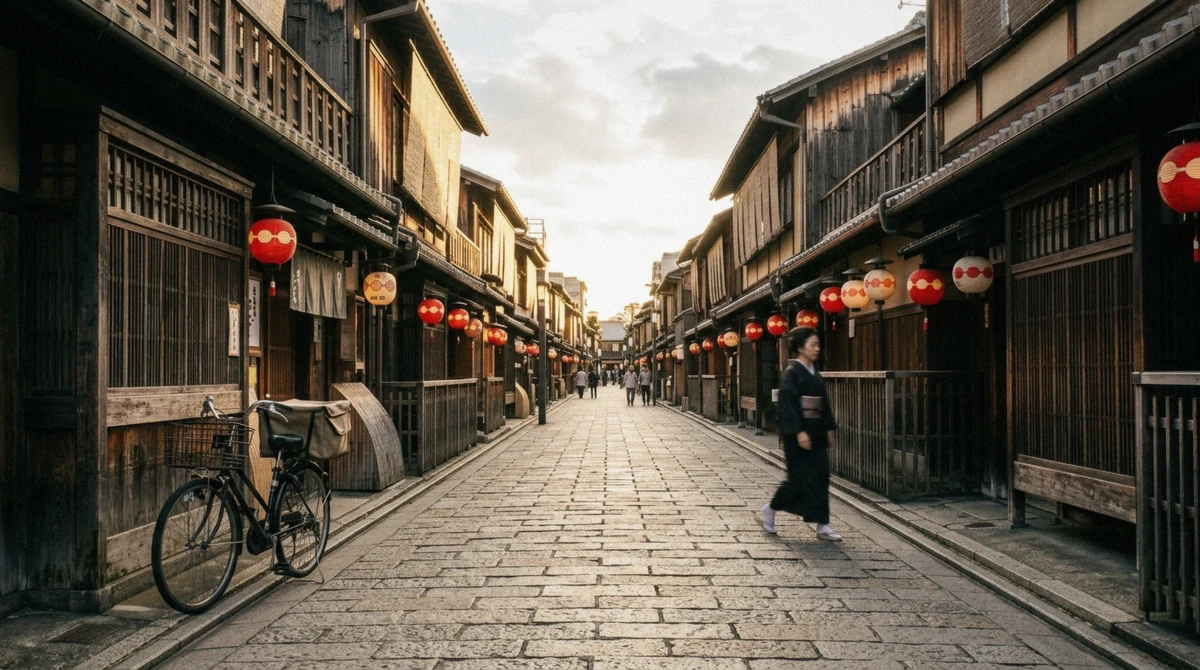
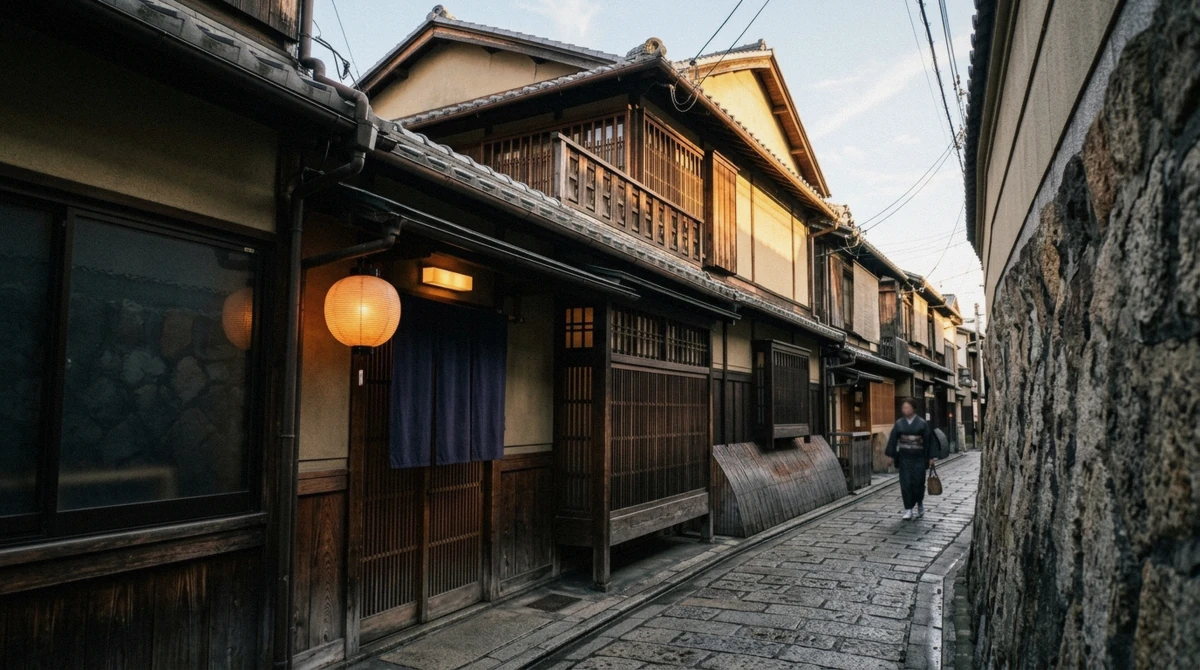
Hanamikoji-dori itself, the main north-south street through Gion Kobu, is public and stays open to photography end to end. What changes is the moment you step off it. Running off Hanamikoji are a handful of narrow lanes lined with ochaya (teahouses) and private residences, Kosode Koji among them, and every one of those lanes is now private property closed to visitors.
You will see the boundary marked clearly: a no-entry sign at the mouth of the lane, printed in Japanese, English and Chinese, reading in English "Private Road Do Not Enter Fine up to ¥10,000." The Japanese text goes further, stating plainly that entry and photography by tourists and by guided tours are both prohibited. These lanes are short, often only wide enough for two people to pass, and they lead directly to ochaya entrances where geiko and maiko arrive for appointments; there is no legitimate reason for a visitor to be in one, since none of them lead anywhere a tourist needs to go.
The practical test is easy to apply as you walk: if you are still on Hanamikoji-dori, Shirakawa-dori or one of the other named public streets, your camera is fine. The instant you turn into a narrow side lane with ochaya on both sides and no through-traffic of shops or restaurants, assume it is private and turn back. Last verified: August 2026.
What the ¥10,000 Charge Really Is
Get the legal status right, because most articles online do not. This is a rule set posted and enforced by the Gion Machiya Association, a local council of the district's own residents and business owners, on land that belongs to its members. Calling it a district council is accurate; calling it city hall is not.
It is not a city ordinance and it is not a national law, and the ¥10,000 figure is not a police fine you would fight in court. It is a charge the council posts on its own private property, the same way a private car park posts a towing fee, and Kyoto City has backed it publicly with its own signage and manners campaigns and funds patrols in the district without making it a city law of its own. Practically, that means a police officer will not write you a citation on the spot; a resident, a patrol volunteer or ochaya staff may ask you to stop, show you the sign, and in a persistent case involve the association, which is the body that actually owns the enforcement.
- October 2019: the Gion Machiya Association first banned photography on the district's private lanes, after incidents that included a geiko having part of her clothing torn and another having a cigarette butt dropped into her collar
- May 2024: the council went further and closed the small private side lanes, Kosode Koji among them, to visitor entry entirely, with no-entry signs going up at the lane mouths
- The Japanese-language signage specifies that both entry and photography by individual tourists and by guided tours are prohibited on these lanes
- Kyoto City supports the rule through its own manners campaigns and district patrols, but the charge itself is council-posted, private-property enforcement, not a municipal fine
Read one paragraph on the Kyoto City official travel site about the district's manners guidance and you will see the same message the signs carry: this is about protecting residents and working women on their own streets, not about restricting tourism generally. Last verified: August 2026.
Map of Where Cameras Are Welcome
Green pins mark public streets and grounds where photography is fine. The single red pin sits on the Hanamikoji side of the private-lane zone; the lanes running off that point, including Kosode Koji, are private and closed to visitors.
Streets and Views You Can Photograph Freely
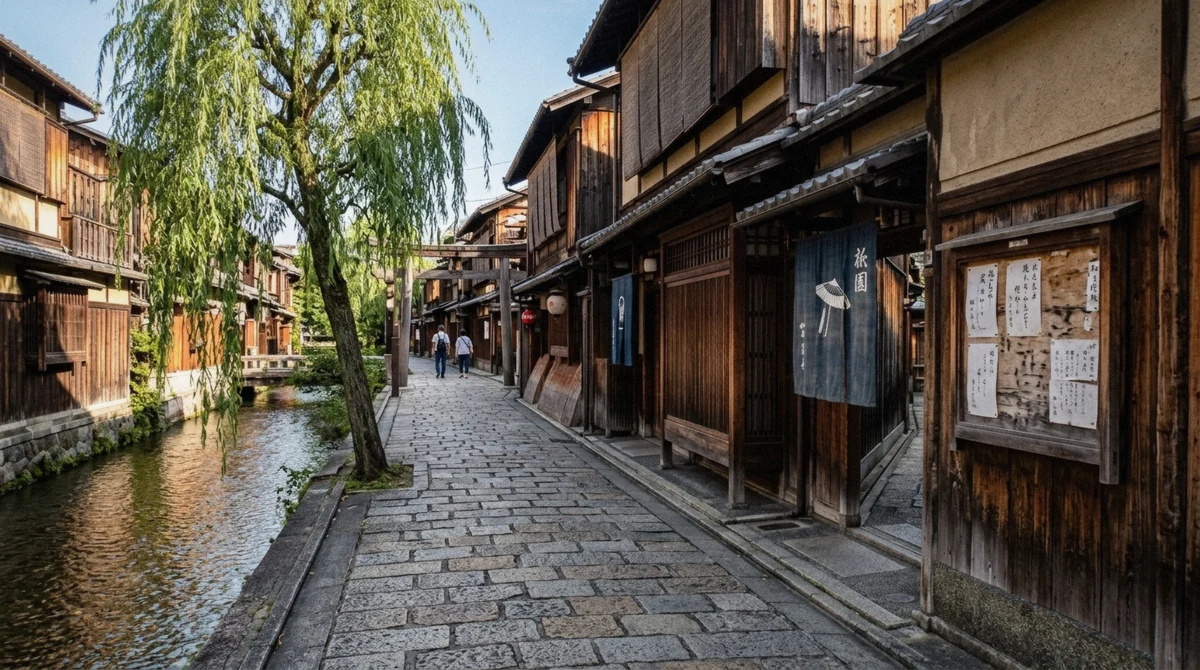
The public map of Gion is bigger than the closures suggest. Hanamikoji-dori, the main street, runs its full length as public road, lanterns, latticed machiya facades, willow trees and all. The Shirakawa canal lane, a short walk northeast, is one of the district's prettiest corners and entirely public, cherry branches over the water at Tatsumi Bridge and stone-paved walking paths either side.
Further south toward Kiyomizu-dera, Sannenzaka and Ninenzaka are two more public stone-stepped lanes, older shopping streets rather than residential ones, and photography there has never been restricted.
Yasaka Shrine's grounds and its approach along Shijo-dori are public and popular at any hour, the vermilion gate and stone lanterns are a reliable frame regardless of season. Kennin-ji, Kyoto's oldest Zen temple and a short walk south of Hanamikoji, keeps its outdoor grounds open to photography during visiting hours, its rock garden and old gate included. The approach to Gion Kobu Kaburenjo, the theatre where the Miyako Odori is staged each April, is public street right up to the building's entrance; only the interior during an actual performance is off-limits.
None of these locations require a permit for personal, non-commercial photography. Even on these open streets, the same courtesy applies to any person in frame, working woman or otherwise: a wide shot of the lane that happens to include someone walking through it is different from turning a camera on a specific person without asking. Last verified: August 2026.
How to Photograph a Maiko With Her Consent
A photograph with a maiko or geiko that involves a real conversation and her consent is available, but not by waiting on a street corner. It comes with a booked experience: some of the evenings on this site build in a dedicated photo moment as part of the format, arranged in advance with the woman's agreement, in a setting where she is working on that basis rather than being stopped mid-errand. The one-hour maiko show with photos and the private maiko experience both build a photograph into the format itself, which is the difference that matters.
Inside those settings, the usual courtesies of any portrait session still apply: ask before using flash, follow the pace the maiko sets rather than directing her, and treat the time as hers as much as yours.
| Situation | What to do |
|---|---|
| A maiko is walking toward you on a public street | Step to the side, lower the camera if you are pointing it at her, and let her pass; a wide shot of the street that happens to include her from a respectful distance is different from following or blocking her |
| Someone (staff, a resident, a maiko herself) asks you to move or stop | Stop immediately and comply without arguing; this is a request on someone's own property or workplace, not a photo opportunity being negotiated |
| A tour guide leads a group toward a private lane | Decline to follow and mention the closure if the guide seems unaware; the private lanes are closed to guided tours by the same signage that closes them to individuals |
| You already took a photo you should not have | Delete it and move on rather than posting it; the point of the rule is the woman's comfort in that moment, not just avoiding the posted charge |
None of this requires guesswork once you know the pattern: public street plus a respectful distance is fine, a private lane or a direct approach never is, and a real photograph with a maiko is something you arrange in advance, not something you catch. The rules exist because of a short list of specific bad behaviour, not because photography itself is unwelcome: chasing someone down a lane for a better angle, blocking a narrow street so she cannot pass, grabbing at a sleeve or an obi to stop her, or firing a flash inches from her face. Every one of those is what the October 2019 signage and the 2024 lane closures were written to stop, and none of them describes an ordinary tourist with a camera who keeps a normal distance.
A geiko or maiko you pass on Hanamikoji at dusk, in full costume, moving with purpose toward an appointment, is on her way to work and cannot be late; treat that walk the way you would treat any professional walking briskly to a meeting, and the etiquette answers itself.
Frequently Asked Questions
Is it illegal to photograph a maiko on a public street in Gion?
No. Public streets, including Hanamikoji-dori, Shirakawa-dori and Sannenzaka, remain open to photography, and there is no law against photographing a person visible on a public street from a respectful distance. The restriction applies specifically to the private lanes off Hanamikoji, not to public roads, so the confusion most visitors run into is treating the whole district as one closed zone when only a handful of side lanes actually are.
What happens if you get caught taking photos on Gion's private lanes?
Signs posted at each lane entrance warn of a charge of up to ¥10,000 (about $63), enforced by the Gion Machiya Association, the district's local residents' and business council, on its own private property. It functions as a private-property penalty rather than a police fine, but ignoring it is treated seriously by the district, and staff or residents may stop you well before it reaches that point.
Which Gion streets are closed to photography entirely?
The small private lanes running off Hanamikoji-dori, including Kosode Koji, have been closed to all visitor entry since May 2024, photography included. Hanamikoji-dori itself, and every other named public street covered on this page, stays open; the closures are narrow and specific, not a district-wide ban, which is easy to miss from the warnings alone.
Do guided tours get an exception to the private lane rule?
No. The Japanese-language signage at the lane entrances specifically prohibits entry and photography by guided tours as well as individual visitors. A guide who leads a group into one of these lanes is breaking the same rule a solo tourist would be, and a reputable operator will route a walking tour along the public streets instead.
Can you photograph the theatre stage during a Miyako Odori performance?
Generally no. Photography of the stage is typically not permitted once a performance is underway at Gion Kobu Kaburenjo or the other district theatres; the exact rule is posted at the door on the day, so check the notice before you sit down.
Where can you get a photo with a maiko legally and with her consent?
Through a booked experience built around a photo moment, arranged with the maiko's agreement in advance. The meet a maiko format and the Gion walking tour with a traditional game both include this rather than relying on a chance encounter.
Why did Kyoto restrict photography in Gion in the first place?
The Gion Machiya Association introduced the ban in October 2019 after specific incidents, including a geiko having part of her clothing torn and another having a cigarette butt dropped into her collar by tourists chasing a photo. The rule protects working women on their own streets, not tourism generally.