Are Kyoto Geisha Shows Authentic or Staged for Tourists?
Yes, if you mean the performers: the maiko and geiko you see at a booked show in Kyoto are real, working professionals from a registered district, doing the same dances and playing the same shamisen they perform at a private banquet. No, if you mean the room around them: the length, the guest list and the format are arranged specifically for visitors, because the traditional route into that room is closed to almost everyone, including most Japanese people. That is the honest shape of the question are geisha shows in Kyoto authentic, and the rest of this guide explains exactly what you are and are not paying for. Compare the geisha shows in Kyoto compared side by side to see which format suits you.
Quick answer
Kyoto geisha shows are authentic in the performer and in the dance, staged in the setting. The maiko or geiko on stage is a real professional from a registered hanamachi doing a genuine, shortened piece from her repertoire; the room, running time and guest list are arranged for visitors because the traditional ochaya system runs on a no-first-time-guests rule almost no traveler can meet on their own. Booking a show is not a fake experience, it is the only realistic door in.
Key takeaways
- The performer is real; the room is arranged for you, and that is the trade-off, not a trick
- Traditional teahouses run on ichigensan okotowari, no first-time guests, which is why almost nobody walks in off the street
- A private hour with a maiko gets you closest to the real rhythm of a genuine evening
- Costumed visitors doing henshin dress-up in daylight near temples are not maiko; a genuine performer is working, not posing
- For what any of this actually costs, from the cheapest evening walk to a true ozashiki, see what a geisha show in Kyoto costs
The short answer on authenticity
Split the question in two and it stops being confusing. Is the performer authentic? Yes, always, at every show worth booking: a real maiko or geiko from one of Kyoto's five hanamachi, performing a genuine piece of kyomai dance to live or recorded shamisen.
Is the evening authentic to what geiko and maiko do every working night? Partly. A private ozashiki runs for hours, follows no fixed script, and includes drinking games, long conversation and a guest list the house already knows.
A booked show compresses that into something closer to a recital: a shorter set, a translated introduction, a room of strangers who paid the same fee rather than one host's personal guests.
- Worth trusting: the performer's training, the dance itself, the shamisen, the kimono
- Arranged for visitors: the length, the running order, the presence of an interpreter, the fact that everyone in the room is a paying stranger to each other
What ichigensan okotowari means for visitors
Traditional ochaya, the teahouses where genuine banquets happen, run on a rule called ichigensan okotowari, "no first-time guests". A house will only take a booking through an established customer who vouches for the new guest and settles the bill afterward, often weeks later, with no invoice at the door. It sounds like snobbery about money, but it is closer to a credit-and-trust system in a business that has never printed a menu or run a card machine at the table: the house needs to know who is arriving and who is responsible for the bill before the evening starts.
- No walk-ins, ever, at a genuine ochaya
- A new guest needs an existing customer's introduction, not just a reservation
- Payment is settled through that relationship afterward, not at the table
- This is why almost no traveler, and most Kyoto residents, will ever sit in a true ozashiki without help
A handful of houses and hotel concierge programmes now arrange introductions for visitors specifically, and that is genuinely the door most people use if they want the traditional route rather than a booked show. It is also why the tourist-facing shows exist at all: they are a separate, parallel format built for exactly the demand ichigensan okotowari was never designed to serve. Roughly 70 geiko and 25 maiko work across Kyoto's five districts today, and only a small share of that community's working hours go to visitor-facing bookings at all; most of a geiko's calendar is still filled by ozashiki through the old introduction system.
What a booked show actually is
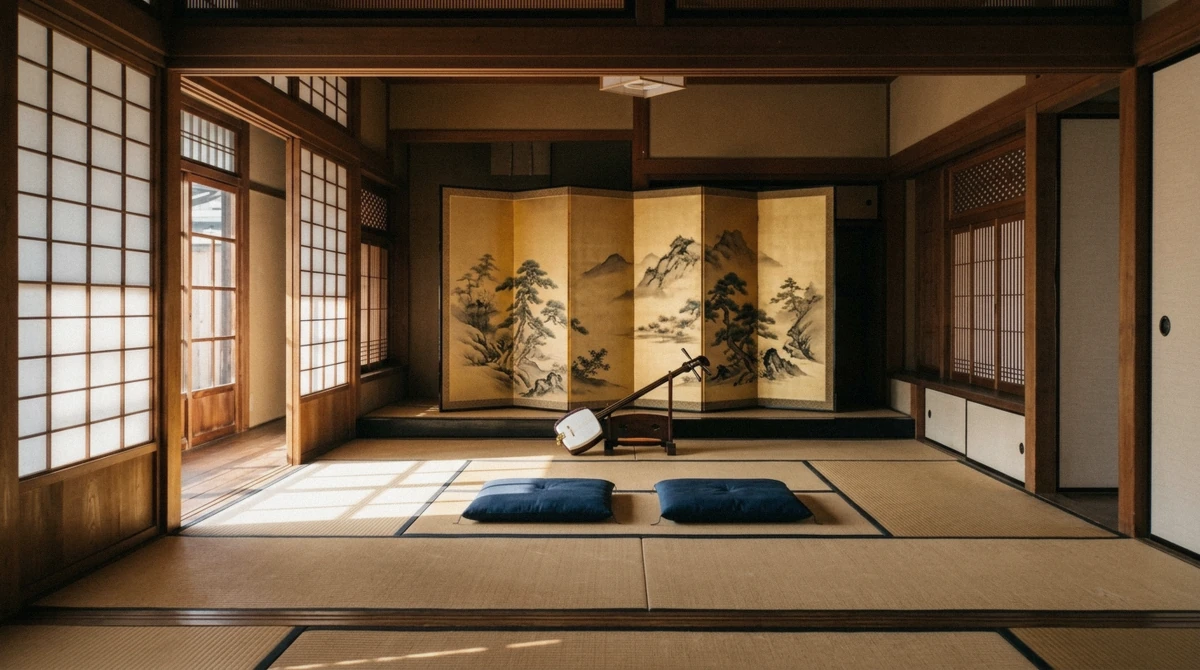
An ozashiki is a private banquet in an ochaya or ryotei, where geiko and maiko dance, pour, play and run drinking games known as ozashiki asobi, for a host and their invited guests. That is the traditional format the booked shows on this site are adapted from, not invented in imitation of. What changes for a visitor booking is scale and length: instead of one host's private party running three or four hours with food, drink and unscripted conversation, a booked show runs a set piece, usually one or two dances of about five minutes each, a Q&A or introduction segment, and a photo opportunity, inside sixty to ninety minutes.
| What you see | Traditional ozashiki | Booked show for visitors |
|---|---|---|
| Who is performing | Real maiko or geiko from a registered hanamachi | The same: real maiko or geiko from a registered hanamachi |
| Length | Several hours, unscripted | 60 to 90 minutes, a fixed programme |
| Guest list | The host's own invited guests | Paying strangers who booked the same slot |
| Content | Dance, drinking games, long conversation | One or two dances, an introduction, often a photo session |
| Access route | Ichigensan okotowari, introduction required | Open booking, no introduction needed |
Nothing in that table makes the booked version fake. It is a real professional performing a real piece of her repertoire in a shortened, translated format built for an audience the traditional system was never designed to admit.
How to check a performance is genuine
A few concrete signals separate a genuine booking from something thinner. None of them require special knowledge, just paying attention to what the listing actually says before you book.
| Signal | What it tells you |
|---|---|
| Is the performer named as a working maiko or geiko from a registered district | Real bookings say which hanamachi she trains or works in; vague listings that only say "geisha dancer" deserve a second look |
| Is the venue a real ochaya or machiya, not a hotel function room | A converted teahouse or merchant house carries the tatami, alcove and low tables the tradition is built around; a hotel ballroom does not, however good the performance inside it |
| Is the dance a named kyomai piece | A genuine programme names the piece and often its seasonal meaning, rather than describing it only as "a traditional dance" |
| Is there live shamisen | Live accompaniment, played by a geiko or a hired musician, is the norm at a genuine show; recorded music alone is a signal to check further |
| Is the photo session consented and scheduled | A fixed, announced photo segment respects the performer's time; being invited to approach her freely between numbers is not how any legitimate booking works |
The honest limits of a tourist show
Say plainly what a booked show cannot give you, because pretending otherwise is exactly the kind of overselling this guide is trying to avoid. It cannot give you the long, unhurried evening of a real ozashiki, where the pace is set by the host and the sake rather than a printed schedule. It cannot give you the natural rhythm of the drinking games, which build over hours between people who already know each other, not in a single scheduled round with strangers.
And it cannot give you the conversation in Kyoto dialect and local reference that a geiko uses with a regular customer she has hosted for years; the version you get, however warm, is adapted for a first meeting and often a second language.
- No long, unhurried evening; you get a fixed window instead
- No organic drinking-game rhythm built over hours with familiar guests
- No Kyoto-dialect conversation pitched at a regular customer
- What you do get: a real dance, a real performer, and a genuine, if brief, chance to be in the same small room
That trade is the honest price of access under ichigensan okotowari. Nobody outside an established relationship gets the unabridged version, and a booked show is the realistic way most visitors will ever be in the room at all. For scale, the hanadai alone at a real ozashiki runs about ¥30,000 an hour for a maiko's attendance, before food, drink or the room itself; a booked show's one-hour price of $81 or a private hour at $720 per group sits nowhere near that scale, which is part of what you are and are not paying for.
Full numbers, including Gion Corner's everyday ticket and a genuine ozashiki running ¥400,000 to ¥600,000 for two or three guests, are in what a geisha show in Kyoto costs. Last verified: August 2026.
Costumed visitors are not maiko
One more authenticity question worth answering directly: the women you see in full maiko costume in broad daylight around Kiyomizu-dera, posing for photos with a friend, are almost always visitors in a paid henshin dress-up session, not working maiko. The tell is straightforward: daytime, a camera-ready pose held for a photograph, and a friend doing the photographing. A working maiko or geiko is on her way to or from an appointment, moving with purpose, usually around dusk, and is never posing for a stranger's camera on the street.
Neither group should be treated as a photo opportunity to chase, but only one of them is actually a professional at work.
Which Evening Fits You
If You want the closest thing to a real ozashiki's intimacy without an introduction
Book the private maiko experience; one hour, dance, tea and conversation with a single apprentice rather than a shared room.
If You want to see the full sequence, walk the district and eat a proper meal around the performance
The Gion dinner show pairs a geiko's performance with a walking tour and dinner, the fullest evening on this site.
If You have a tight budget or a short window and just want to see a maiko dance once
The one-hour show with photos covers the dance, a short Q&A and a photo session without the cost of a private booking.
If You are undecided and just want to understand the district before committing to a show
Take an evening Gion walking tour first; it costs little, sets real expectations, and you can book a show afterward.
If You want the genuine, unabridged ochaya evening and have the budget for it
That route runs through a personal introduction, not a listing page; expect a very different price than any booked show here, covered in full in what a geisha show in Kyoto costs.
Who should book which evening
Different travelers want different things from this question, and the honest answer changes depending on what you actually value; the picks above match evening to traveler.
Ask are geisha shows in Kyoto authentic and expect a yes-or-no answer, and you will end up either dismissing something genuinely real or trusting something more arranged than advertised. Ask it the way this guide does, performer real, room arranged, and it stops being a trick question. Book with that understanding and a good show will not disappoint you; it was never pretending to be an ochaya evening in the first place.
Frequently Asked Questions
Are the dancers at a Kyoto geisha show really maiko or geiko?
Yes, at any show worth booking. The performer is a real, working maiko or geiko from one of Kyoto's registered hanamachi, not an actor or a costumed model. What is arranged for visitors is the room and the running time, not the performer's credentials.
Why can't I just book a table at a real teahouse?
Traditional ochaya operate under ichigensan okotowari, no first-time guests. A house takes bookings only through an established customer who vouches for you, which is why almost no traveler can walk in directly; a booked show is the realistic alternative route in.
Is a booked geisha show worth the money compared to a real ozashiki?
For most visitors, yes, because a genuine ozashiki is not actually purchasable without an introduction at any price. Compare a booked show against what it offers, a real performer and a real dance in a shortened format, rather than against an ochaya evening you cannot book anyway. See the full cost breakdown for both.
How can I tell if a listing is a genuine performance and not a gimmick?
Check whether the performer is named as working in a specific hanamachi, whether the venue is a real ochaya or machiya rather than a hotel function room, and whether the dance is named. Live shamisen and a scheduled, consented photo segment are further good signs.
Do the shows use recorded music instead of live shamisen?
It varies by booking, and it is worth checking before you pay. Live shamisen, played by a geiko or a hired musician, is the norm at a genuine show and one of the clearer signals of authenticity; a listing that says nothing about music at all is worth a second look.
Are the women in full costume near Kiyomizu-dera in daylight actual maiko?
Almost never. Daytime, a camera-ready pose and a friend taking the photo are the tell of a paid henshin dress-up visitor, not a working apprentice. A real maiko is moving with purpose to an appointment, usually around dusk, not posing for strangers.